


Test Owner
How to show judgment, not just deal volume, in PE interviews

A lot of candidates answer PE interview questions by listing transactions.
That is not the same as showing judgment.
The more convincing answer usually explains:
• what you noticed early
• what risk you were most focused on
• what changed your level of conviction
• where you disagreed with the easy consensus
In other words, not just what happened, but how you thought.
Senior investors are rarely looking for a perfect script.
They are looking for signs that you can process ambiguity, weigh trade-offs and make sensible calls with imperfect information.
Deal volume may get you into the conversation.
Judgment is usually what moves you forward.
At Circle Square, we work with investment professionals who know the difference — and help firms identify candidates with genuine commercial judgment, not just a polished deal sheet.
If you are building out your investment team or looking for your next role, get in touch.
Why we stay close after placement — and how that improves outcomes
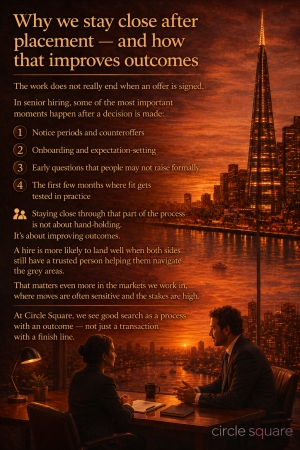
The work does not really end when an offer is signed.
In senior hiring, some of the most important moments happen after a decision is made:
1. Notice periods and counteroffers
2. Onboarding and expectation-setting
3. Early questions that people may not raise formally
4. The first few months where fit gets tested in practice
Staying close through that part of the process is not about hand-holding.
It’s about improving outcomes.
A hire is more likely to land well when both sides still have a trusted person helping them navigate the grey areas.
That matters even more in the markets we work in, where moves are often sensitive and the stakes are high.
At Circle Square, we see good search as a process with an outcome — not just a transaction with a finish line.
The Rise of “Quiet Hiring” in Investment Banking and Private Equity
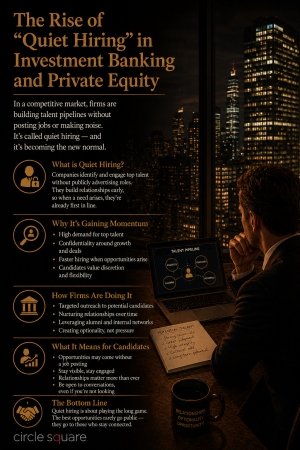
Not every hire is being advertised anymore.
In fact, some of the most strategic hires in IB and PE are happening quietly—before the market even knows a role exists.
What is “quiet hiring”?
???? Building relationships with talent before a role is live
???? Hiring opportunistically when the right individual becomes available
???? Strengthening teams without launching a formal process
Why firms are adopting this approach
???? Reduces competition for top candidates
???? Maintains confidentiality around growth plans
???? Speeds up hiring when timing matters
What it requires internally
???? Quiet hiring only works if firms are:
???? Clear on what “great” looks like
???? Aligned internally on hiring priorities
???? Open to meeting candidates without an immediate need
The risk of not adapting
If you only hire when there’s an urgent vacancy:
???? You’re already late
???? You’re competing with multiple processes
???? You’re forced into reactive decisions
The advantage
Firms that consistently build relationships with top talent:
???? Move faster
???? Hire better
???? Avoid compromised decisions
The bottom line
The best hires often aren’t planned.
They’re identified early—and secured before anyone else is aware. Reach out to find out how Circle Square can help you build your team.
What a good shortlist should do — and what ours is designed to avoid
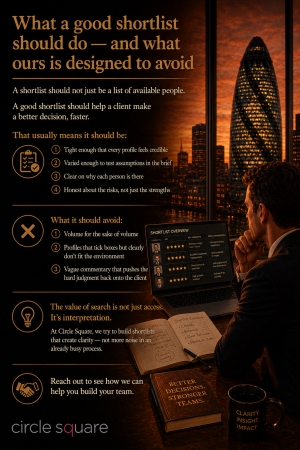
A shortlist should not just be a list of available people.
A good shortlist should help a client make a better decision, faster.
That usually means it should be:
1. Tight enough that every profile feels credible
2. Varied enough to test assumptions in the brief
3. Clear on why each person is there
4. Honest about the risks, not just the strengths
What it should avoid:
1. Volume for the sake of volume
2. Profiles that tick boxes but clearly don’t fit the environment
3. Vague commentary that pushes the hard judgment back onto the client
The value of search is not just access.
It’s interpretation.
At Circle Square, we try to build shortlists that create clarity — not more noise in an already busy process. Reach out to see how we can help you build your team.
Senior interviews reward judgment, not just execution
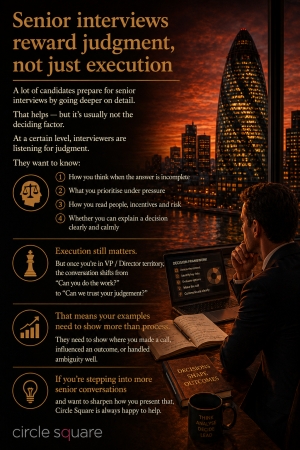
A lot of candidates prepare for senior interviews by going deeper on detail.
That helps — but it’s usually not the deciding factor.
At a certain level, interviewers are listening for judgment.
They want to know:
1. How you think when the answer is incomplete
2. What you prioritise under pressure
3. How you read people, incentives and risk
4. Whether you can explain a decision clearly and calmly
Execution still matters.
But once you’re in VP / Director territory, the conversation shifts from “Can you do the work?” to “Can we trust your judgement?”
That means your examples need to show more than process.
They need to show where you made a call, influenced an outcome, or handled ambiguity well.
If you’re stepping into more senior conversations and want to sharpen how you present that, Circle Square is always happy to help.
What Actually Makes a Top Performer in Private Equity or Investment Banking?
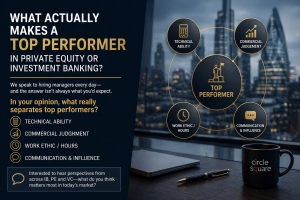
In Private Equity and Investment Banking, the definition of a “top performer” is often assumed to be straightforward.
Strong academics.
Solid technical skills.
A track record of working hard.
But in reality, it’s rarely that simple.
At Circle Square, we speak to hiring managers across IB, PE, and VC on a daily basis—and the answer isn’t always what you’d expect. As the market becomes more selective and hiring more precise, firms are placing increasing emphasis on qualities that go beyond the traditional checklist.
So what really separates the top performers from the rest?
Is it technical ability—the foundation every candidate is expected to have?
Is it commercial judgement—the ability to see the bigger picture behind the numbers?
Does it come down to work ethic and hours—still a defining feature of the industry?
Or is it communication and influence—the skill that turns analysis into action?
The reality is that the answer often depends on the firm, the team, and the stage of the investment cycle. But what’s clear is that expectations are evolving—and understanding what matters most has never been more important for both candidates and hiring managers.
We’re currently running a poll on our LinkedIn page to gather perspectives from across the market.
???? Have your say and vote here: https://www.linkedin.com/posts/circle-square-talent_activity-7453031584401625088-C8XX?utm_source=share&utm_medium=member_desktop&rcm=ACoAACoUrJkB_MxDZ-UlVcdgXmsWzWjx9NoaU4c
We’re particularly interested to hear from professionals across Investment Banking, Private Equity, and Venture Capital.
What do you think defines a top performer in today’s market?
How to Stand Out in M&A Interviews in a More Selective Market
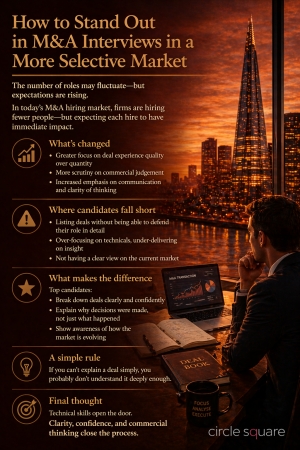
The number of roles may fluctuate—but expectations are rising.
In today’s M&A hiring market, firms are hiring fewer people—but expecting each hire to have immediate impact.
What’s changed
- Greater focus on deal experience quality over quantity
- More scrutiny on commercial judgement
- Increased emphasis on communication and clarity of thinking
Where candidates fall short
- Listing deals without being able to defend their role in detail
- Over-focusing on technicals, under-delivering on insight
- Not having a clear view on the current market
What makes the difference
Top candidates:
- Break down deals clearly and confidently
- Explain why decisions were made, not just what happened
- Show awareness of how the market is evolving
A simple rule
If you can’t explain a deal simply, you probably don’t understand it deeply enough.
Final thought
Technical skills open the door.
Clarity, confidence, and commercial thinking close the process.
Why Your Hiring Process Is Costing You Top Talent in 2026
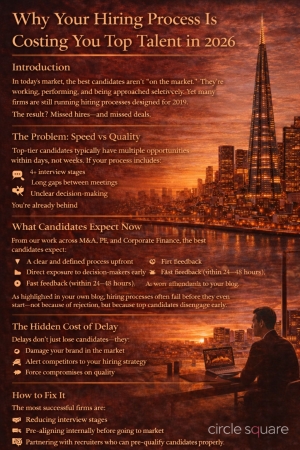
Introduction
In today’s market, the best candidates aren’t “on the market.” They’re working, performing, and being approached selectively. Yet many firms are still running hiring processes designed for 2019.
The result? Missed hires—and missed deals.
The Problem: Speed vs Quality
Top-tier candidates typically have multiple opportunities within days, not weeks. If your process includes:
- 4+ interview stages
- Long gaps between meetings
- Unclear decision-making
You’re already behind.
What Candidates Expect Now
From our work across M&A, PE, and Corporate Finance, the best candidates expect:
- A clear and defined process upfront
- Direct exposure to decision-makers early
- Fast feedback (within 24–48 hours)
Hiring processes often fail before they even start—not because of rejection, but because top candidates disengage early.
The Hidden Cost of Delay
Delays don’t just lose candidates—they:
- Damage your brand in the market
- Alert competitors to your hiring strategy
- Force compromises on quality
How to Fix It
The most successful firms are:
- Reducing interview stages
- Pre-aligning internally before going to market
- Partnering with recruiters who can pre-qualify candidates properly
Conclusion
Hiring in 2026 is no longer about volume—it’s about precision.
At Circle Square, we help clients secure high-calibre candidates before they ever hit the open market.
Why You’re Not Getting Offers After Finance Interviews
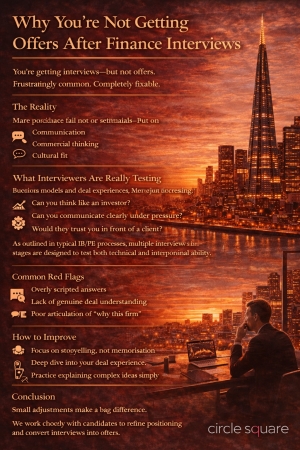
Introduction
You’re getting interviews—but not offers.
Frustratingly common. Completely fixable.
The Reality
Most candidates fail not on technicals—but on:
- Communication
- Commercial thinking
- Cultural fit
What Interviewers Are Really Testing
Beyond models and deal experience, firms are assessing:
- Can you think like an investor?
- Can you communicate clearly under pressure?
- Would they trust you in front of a client?
As outlined in typical IB/PE processes, multiple interview stages are designed to test both technical and interpersonal ability.
Common Red Flags
- Overly scripted answers
- Lack of genuine deal understanding
- Poor articulation of “why this firm”
How to Improve
- Focus on storytelling, not memorisation
- Deep dive into your deal experience
- Practice explaining complex ideas simply
Conclusion
Small adjustments make a big difference.
We work closely with candidates to refine positioning and convert interviews into offers.
The Analyst Bottleneck: Why Your Deal Team Isn’t Scaling Properly

Many mid-market advisory firms are growing—but hitting a ceiling.
The issue? Not Directors. Not deal flow.
It’s the Analyst and Associate pipeline underneath.
The Real Problem
Firms often hire reactively at junior levels:
1️⃣ Hiring only when deal flow spikes
2️⃣ Relying on CVs rather than targeted search
3️⃣ Competing on compensation alone
What the Market Is Doing
In 2025–2026, we’re seeing:
1️⃣ Increased demand for execution-heavy junior talent
2️⃣ Candidates prioritising development, exposure, and culture over salary
3️⃣ Strong Analysts moving quickly into Associate roles
As deal complexity rises, firms need people who can operate autonomously earlier in their careers.
The Consequence
Without a strong junior pipeline:
1️⃣ Senior staff become execution-heavy
2️⃣ Deal timelines slow down
3️⃣ Burnout increases across teams
The Solution
Top-performing firms are:
1️⃣ Building pipelines before they need them
2️⃣ Hiring “ahead of the curve”
3️⃣ Partnering with specialist recruiters who understand technical fit + cultural fit
Conclusion
Your next hire shouldn’t just fill a gap—it should futureproof your team.
We work with clients to build scalable, high-performing deal teams from the ground up.


